Waiting Well: What Luxury Means When Everything Arrives in an Hour
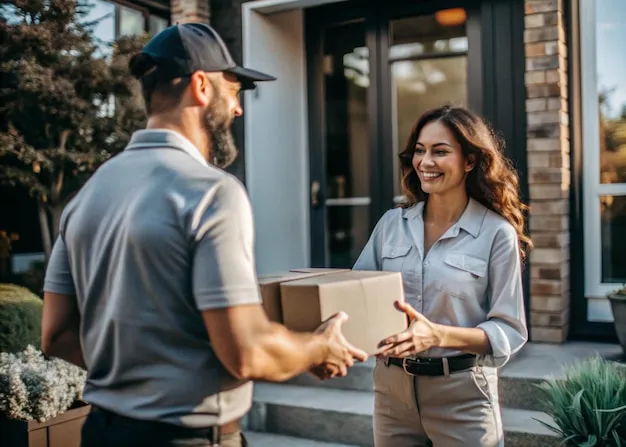
Photo: courier handing premium package to customer at doorstep golden hour, via img.freepik.com
Somewhere in America right now, a courier is weaving through traffic with someone's order in the passenger seat — a bottle of something special, a pair of boots, a carton of a favorite blend — due at a doorstep within the hour. This is not a glimpse of the future. It's Tuesday.
Same-day delivery, once a white-glove perk reserved for Manhattan penthouses, has metastasized into the default expectation of American e-commerce. And in doing so, it has quietly broken one of retail's oldest equations: that luxury means getting things fast.
When Speed Stopped Being Special
For most of the twentieth century, waiting was the tax on desire. You saw something in a catalog, you ordered it, and you waited weeks — and the wait was part of the romance. The Sears catalog era made anticipation a national pastime.
Then the logistics revolution arrived. Two-day shipping became one-day, one-day became same-day, and in dense metro areas — Dallas, Atlanta, Seattle, Chicago — the window keeps shrinking toward the absurd. Speed, once the signature of premium service, became infrastructure. Nobody brags about their water pressure. Soon, nobody will brag about delivery time.
This creates a genuine problem for premium brands. If a customer can get a generic version of anything in ninety minutes, then 'we're fast' is no longer a reason to buy the expensive version. The luxury tier has to offer something speed can't.
The Pivot: Competing on Experience, Not Velocity
Look closely at the best premium retailers in the US right now and you'll notice a pattern: they're not racing to the bottom on delivery windows. They're racing upward on everything else that surrounds the delivery.
That means packaging worth keeping. It means curbside handoffs instead of doorstep drops, with a human who knows your name. It means the shipment arrives when the ritual calls for it — not the moment you clicked, but the evening you actually planned to enjoy it. Some specialty retailers now let customers schedule delivery to the hour, treating timing as a courtesy rather than a constraint.
The insight underneath all of this is almost paradoxical: once everyone can be fast, the differentiator becomes thoughtfulness. Speed is a logistics metric. Thoughtfulness is a brand.
The Return of Anticipation
There's also a quieter cultural shift underway among shoppers themselves. After a decade of one-click everything, a segment of American consumers is rediscovering that anticipation is not the enemy of enjoyment — it's a component of it.
Behavioral researchers have long noted that the pleasure of a purchase is distributed across time: the browsing, the choosing, the waiting, the arrival, the use. Instant delivery compresses all of that into a blur, and the blur feels strangely forgettable. The package that shows up forty minutes later is often less memorable than the one you tracked across three states.
Smart premium brands have started designing for this deliberately. Limited releases with announced windows. Small-batch drops with real lead times. Order tracking that tells a story rather than just a location. The wait, done well, is a feature — a runway that lets enjoyment take off before the box is even open.
What 'Waiting Well' Looks Like
For shoppers, the new skill is knowing which purchases deserve speed and which deserve ceremony. Groceries and replacements? Ship it fast, nobody's grading the experience. But the things you buy to mark a moment — a celebration, a wind-down, a gift to yourself after a long season — those benefit from a little runway.
A few habits worth adopting:
Order the ritual items early on purpose. Build the anticipation into your calendar instead of against it.
Choose brands that communicate during the wait. A thoughtful update beats a silent tracking number every time.
Savor the arrival as an event. Open it properly. Notice the packaging. The brands that care will have made it worth noticing.
The New Definition
Premium, it turns out, was never really about the stopwatch. It was always about care — care in the making, care in the selling, care in the delivery. Speed was just the easiest proxy, and proxies get commoditized.
So when everything can arrive in an hour, the brands that win are the ones that make you glad you waited — and the shoppers who win are the ones who've learned that the best things in life still take a couple of days. Delivered to your door, yes. But delivered with intention.